Surface types
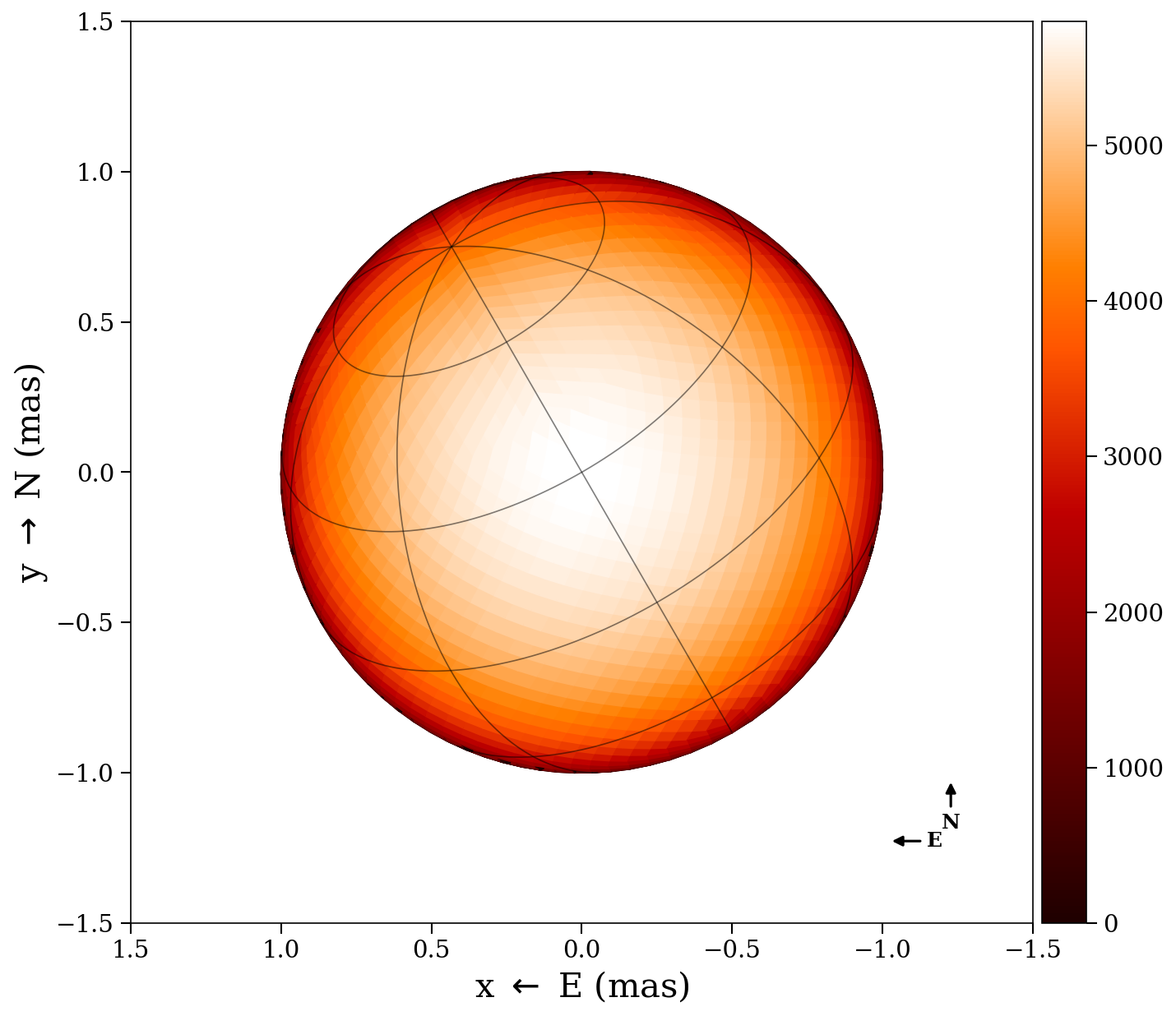
ROTIR supports four surface geometries, selected by the surface_type field in the star parameters. Each geometry computes a different radial profile and gravity-darkened temperature map.
Sphere (surface_type = 0)
The simplest model: a uniform-radius sphere. Use this when the star is not significantly distorted.
star_params = (
    surface_type    = 0,
    radius          = 1.0,      # angular radius (mas)
    tpole           = 5000.0,   # temperature (K)
    ldtype          = 3,        # Hestroffer limb darkening
    ld1             = 0.23,
    ld2             = 0.0,
    inclination     = 60.0,     # degrees
    position_angle  = 30.0,     # degrees
    rotation_period = 10.0,     # days
)
A sphere produces a uniform temperature map — there is no oblateness, so the von Zeipel law gives constant temperature everywhere.
Triaxial ellipsoid (surface_type = 1)
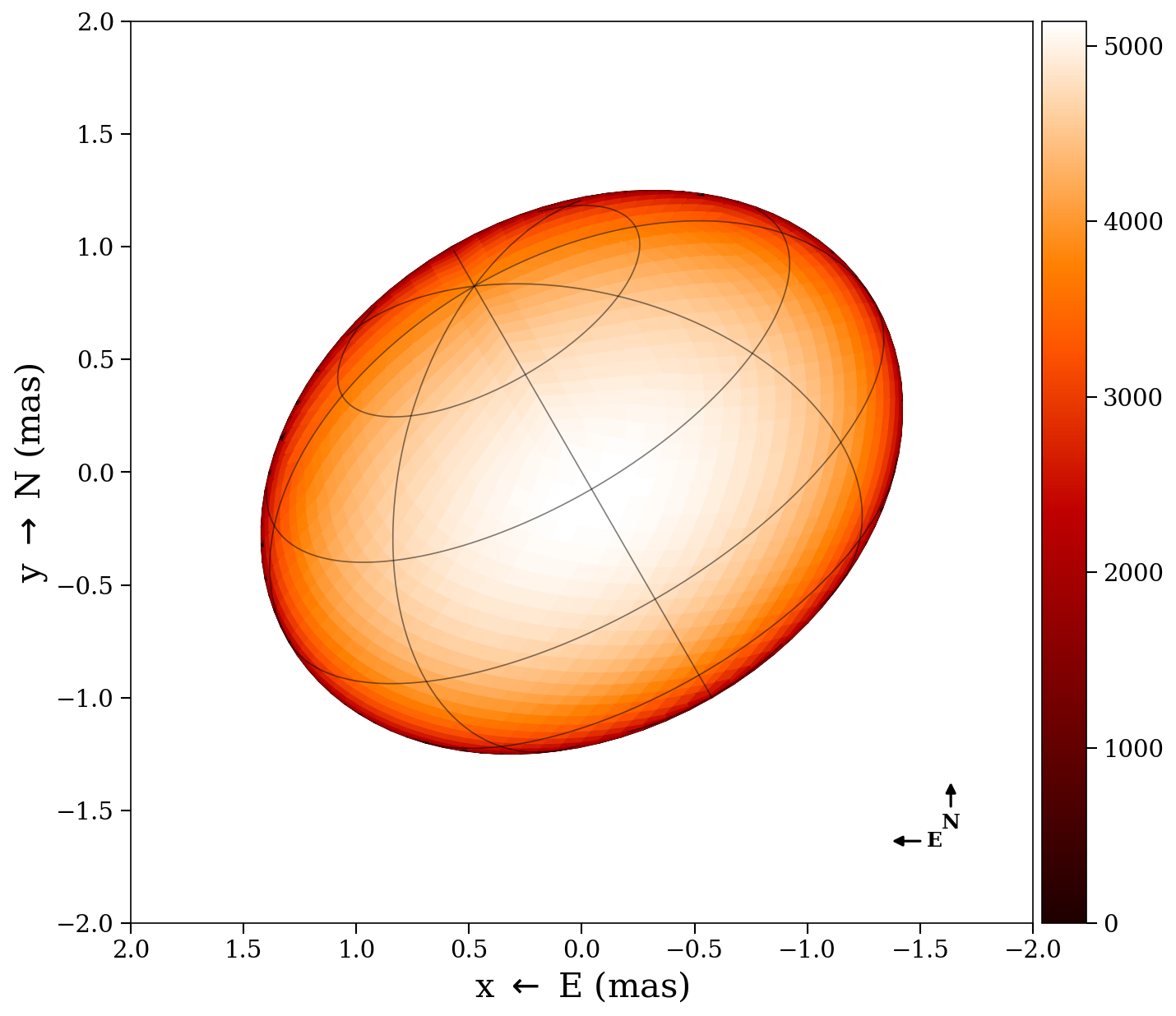
Three independent semi-axes (rx, ry, rz) define an ellipsoidal surface. Useful for modeling tidally or rotationally distorted stars where the exact distortion mechanism is not assumed.
star_params = (
    surface_type    = 1,
    radius_x        = 1.5,     # semi-axis along x (mas)
    radius_y        = 1.3,     # semi-axis along y (mas)
    radius_z        = 1.1,     # semi-axis along z (mas)
    tpole           = 4800.0,
    ldtype          = 3,
    ld1             = 0.23,
    ld2             = 0.0,
    inclination     = 78.0,
    position_angle  = 24.0,
    rotation_period = 54.8,
    beta            = 0.08,    # von Zeipel exponent
)
The von Zeipel temperature map for an ellipsoid uses temperature_map_vonZeipel_ellipsoid, which computes the local gravity as g ~ 1/r^2 in ellipsoidal coordinates.
Rapid rotator (surface_type = 2)
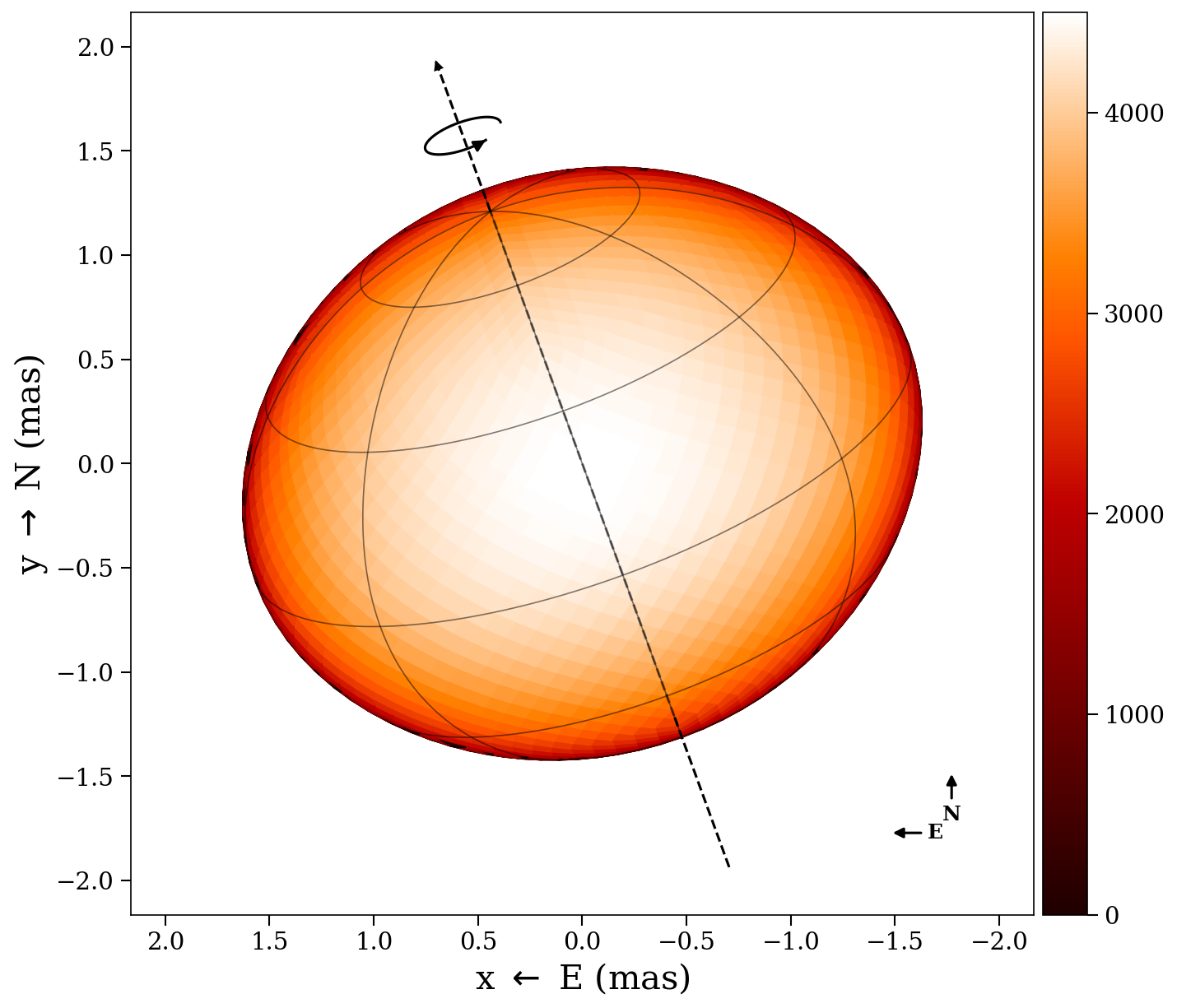
A star distorted by centrifugal forces. The shape is determined by two parameters: the polar radius rpole and the fractional rotational velocity frac_escapevel (omega = vrot / vescape at the equator, ranging from 0 to 1).
The equatorial radius is given by the Roche model for a single rotating star (the equipotential surface of a rigidly rotating body with a point-mass gravitational field):
r(theta) = rpole * f(omega * sin(theta))where f(x) = 3*cos((pi + acos(x))/3) / x, theta is the colatitude, and omega is the frac_escapevel parameter (ratio of equatorial rotational velocity to breakup velocity, 0 to 1). At omega = 0 the star is a sphere (f = 1); at omega = 1 it reaches critical rotation.
star_params = (
    surface_type    = 2,
    rpole           = 1.37,    # polar radius (mas)
    tpole           = 4800.0,  # polar temperature (K)
    ldtype          = 3,
    ld1             = 0.23,
    ld2             = 0.0,
    inclination     = 78.0,
    position_angle  = 24.0,
    rotation_period = 54.8,
    beta            = 0.08,    # von Zeipel exponent: T ∝ g^β (e.g. 0.25 radiative, 0.08 convective)
    frac_escapevel  = 0.9,     # omega: 0 = no rotation, 1 = critical rotation
    B_rot           = 0.0,     # differential rotation coefficient
)
The von Zeipel law gives the temperature map:
T_eff(theta) = T_pole * (g(theta) / g_pole)^betawhere the local effective gravity includes centrifugal and gravitational terms:
g_r     = -GM/r^2 + r * (omega * sin(theta))^2
g_theta = omega^2 * r * sin(theta) * cos(theta)
g       = sqrt(g_r^2 + g_theta^2)
The equator-to-pole radius ratio and temperature contrast depend on omega. The temperature column uses beta = 0.25, the classical von Zeipel (1924) value for radiative envelopes. Typical reference values are beta = 0.25 (radiative, von Zeipel 1924) and beta = 0.08 (fully convective, Lucy 1967), but beta can take any value — Claret (2000) computes it as a continuous function of effective temperature and evolutionary stage.
| omega | Req / Rpole | Teq / Tpole (beta=0.25) |
|---|---|---|
| 0.0 | 1.00 | 1.00 |
| 0.5 | 1.04 | 0.96 |
| 0.9 | 1.28 | 0.80 |
| 0.99 | 1.45 | 0.68 |
Oblateness progression
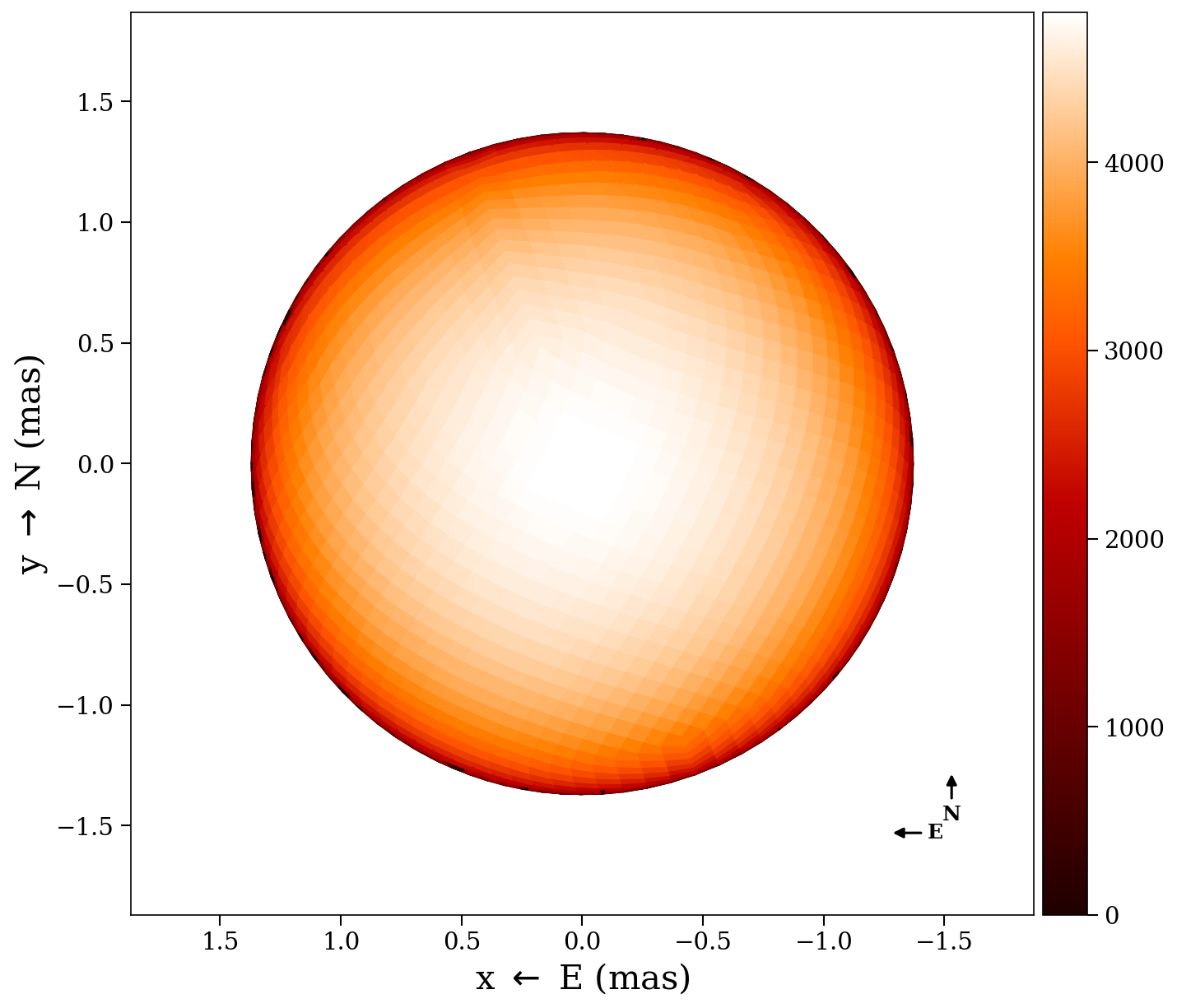
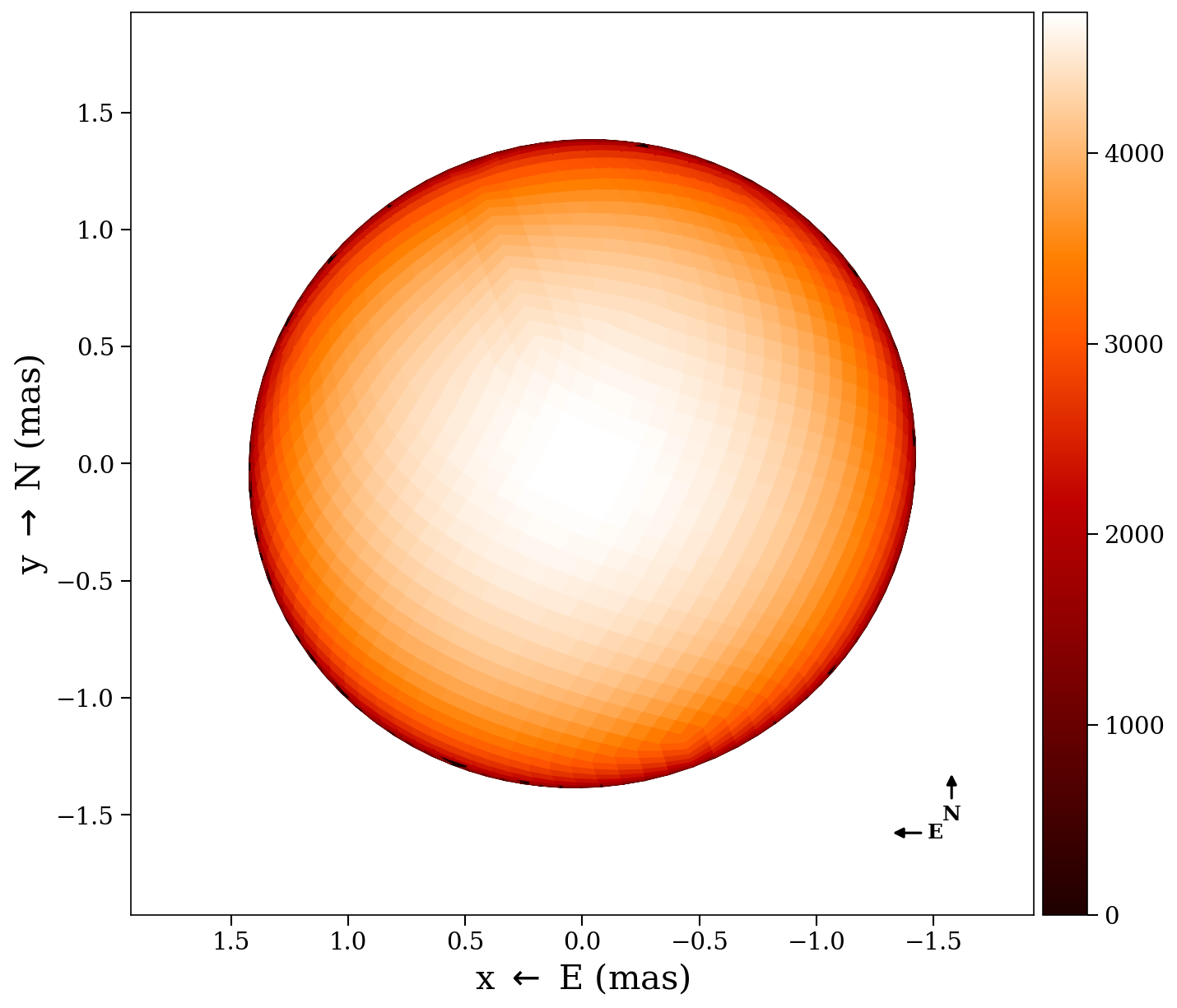
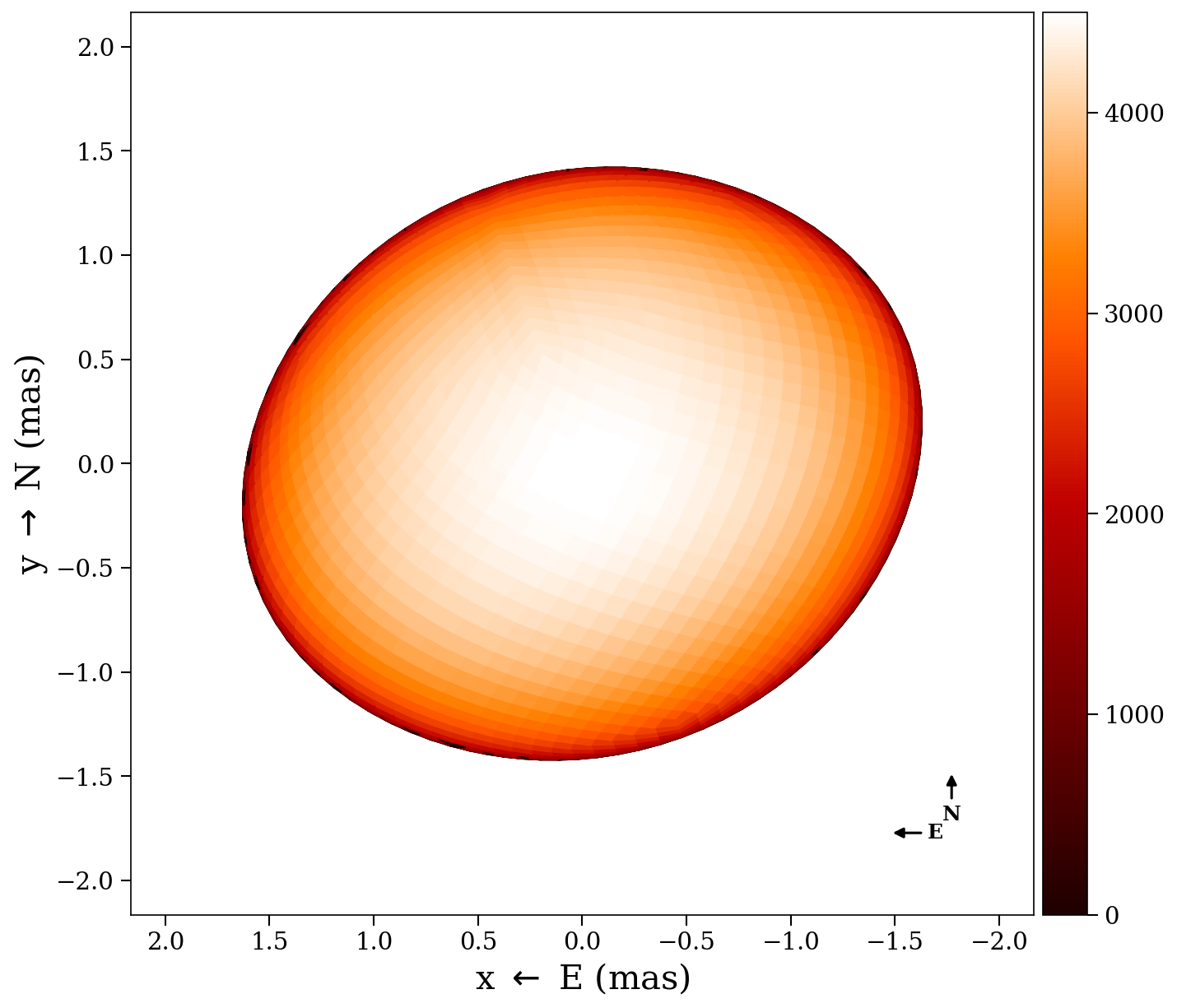
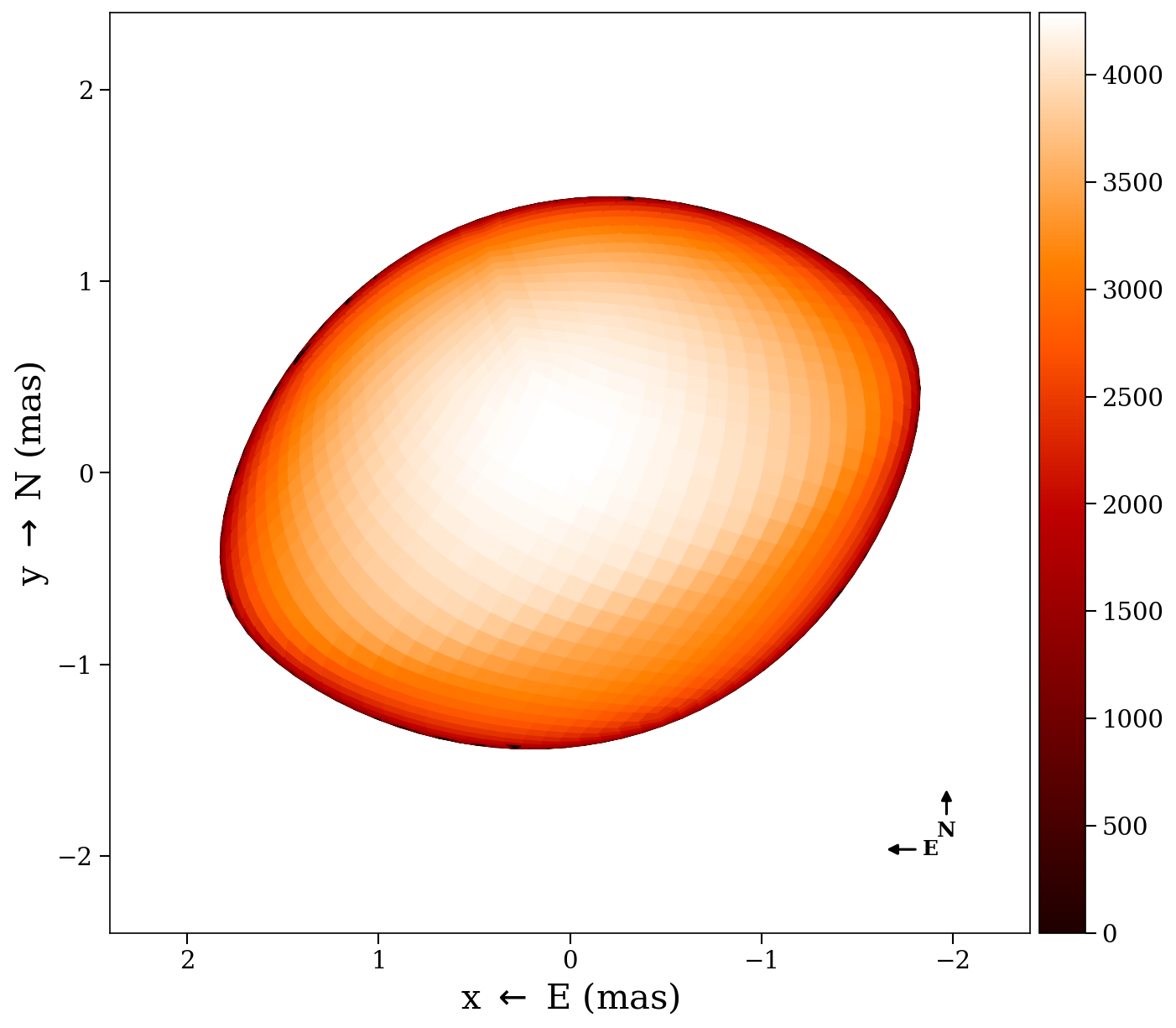
Increasing frac_escapevel (omega) from 0 to near-critical rotation:
| omega = 0.0 | omega = 0.5 | omega = 0.9 | omega = 0.99 |
|---|---|---|---|
 |  |  |  |
Helper functions
oblate_const(star_params)– approximates the rapid rotator by an oblate spheroid, returning(a, b, c)semi-axescalc_omega(rpole, oblateness)– converts oblateness to fractional angular velocitycalc_rotspin(rpole, R_equ, omega, Mass)– computes rotational velocity (km/s), period (days), and angular velocity (rad/day)
Roche lobe (surface_type = 3)
For a star filling (or nearly filling) its Roche lobe in a binary system. The shape is determined by the binary potential, mass ratio, and separation.
roche_params = (
    surface_type   = 3,
    rpole          = 0.355,   # polar radius (mas)
    tpole          = 4800.0,
    ldtype         = 3,
    ld1            = 0.23,
    ld2            = 0.0,
    inclination    = 0.0,
    position_angle = 0.0,
    rotation_period = 5.0,
    beta           = 0.08,
    # Binary / Roche parameters
    d              = 77.0,     # distance (parsecs)
    q              = 1.0,      # mass ratio M2/M1
    fillout_factor_primary = -1, # if negative, rpole defines potential
    # Orbital elements
    i  = 0.0,     # orbital inclination (degrees)
    Omega = 0.0,  # longitude of ascending node (degrees)
    omega = 0.0,  # argument of periapsis (degrees)
    P  = 5.0,     # orbital period (days)
    a  = 1.0,     # semi-major axis (mas)
    e  = 0.0,     # eccentricity
    T0 = 0.0,     # time of periastron (JD)
    dP = 0.0,     # period derivative (days/day)
    domega = 0.0, # periapsis precession (degrees/day)
)
The Roche potential is solved numerically using Halley's method (cubic convergence) to find the radius r(theta, phi) at each vertex.
Fillout factor vs. polar radius
Two ways to specify the surface:
- Polar radius (
rpole): directly sets the potential level. Usefillout_factor_primary = -1to disable the fillout factor. - Fillout factor: the ratio of the surface potential to the L1 potential. A value of 1.0 means the star exactly fills its Roche lobe.
Conversion functions:
fillout_to_rpole(fillout, D, q, async_ratio)rpole_to_fillout(rpole, D, q, async_ratio)max_rpole(D, roche_parameters)– maximum polar radius (L1 point)
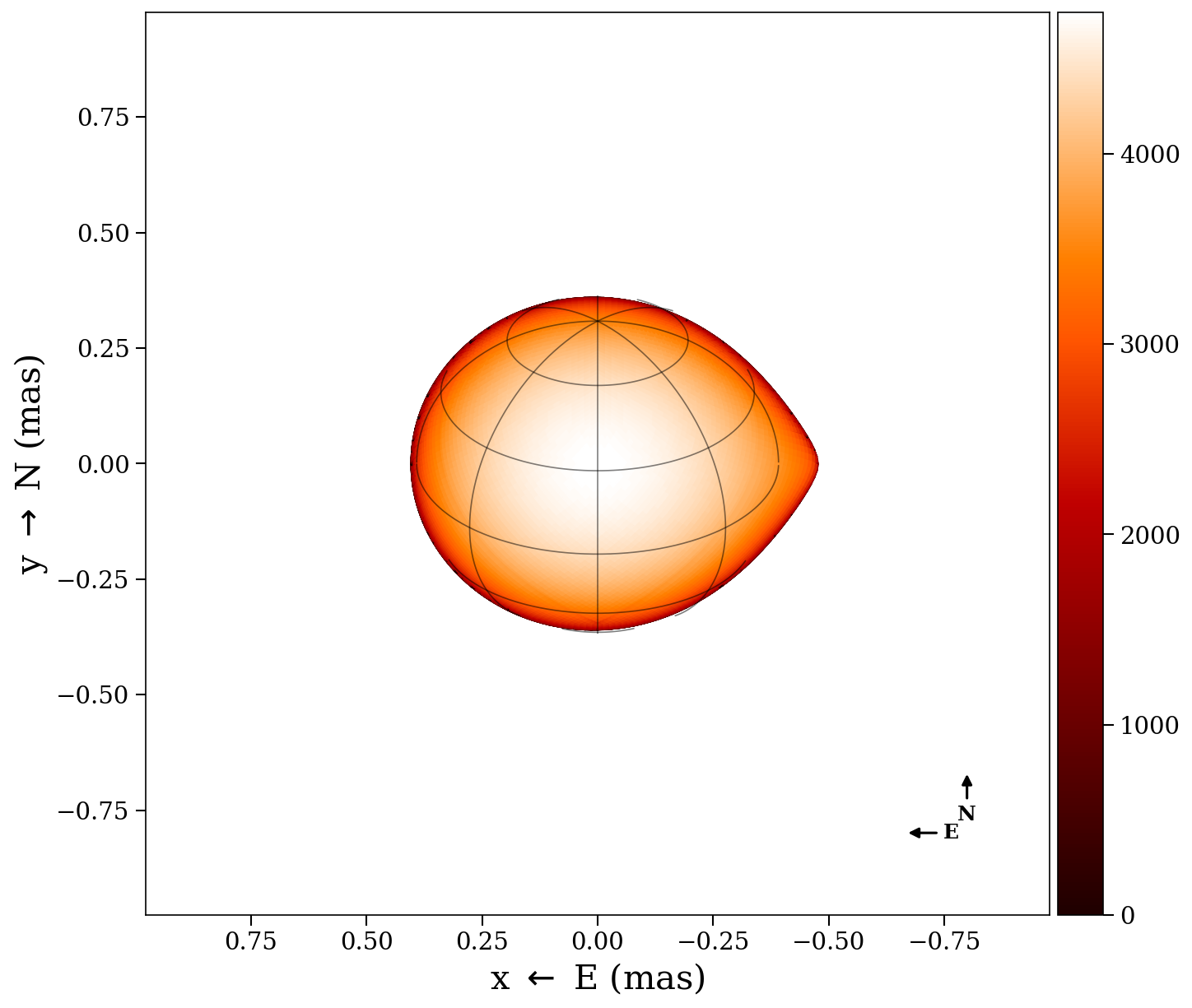
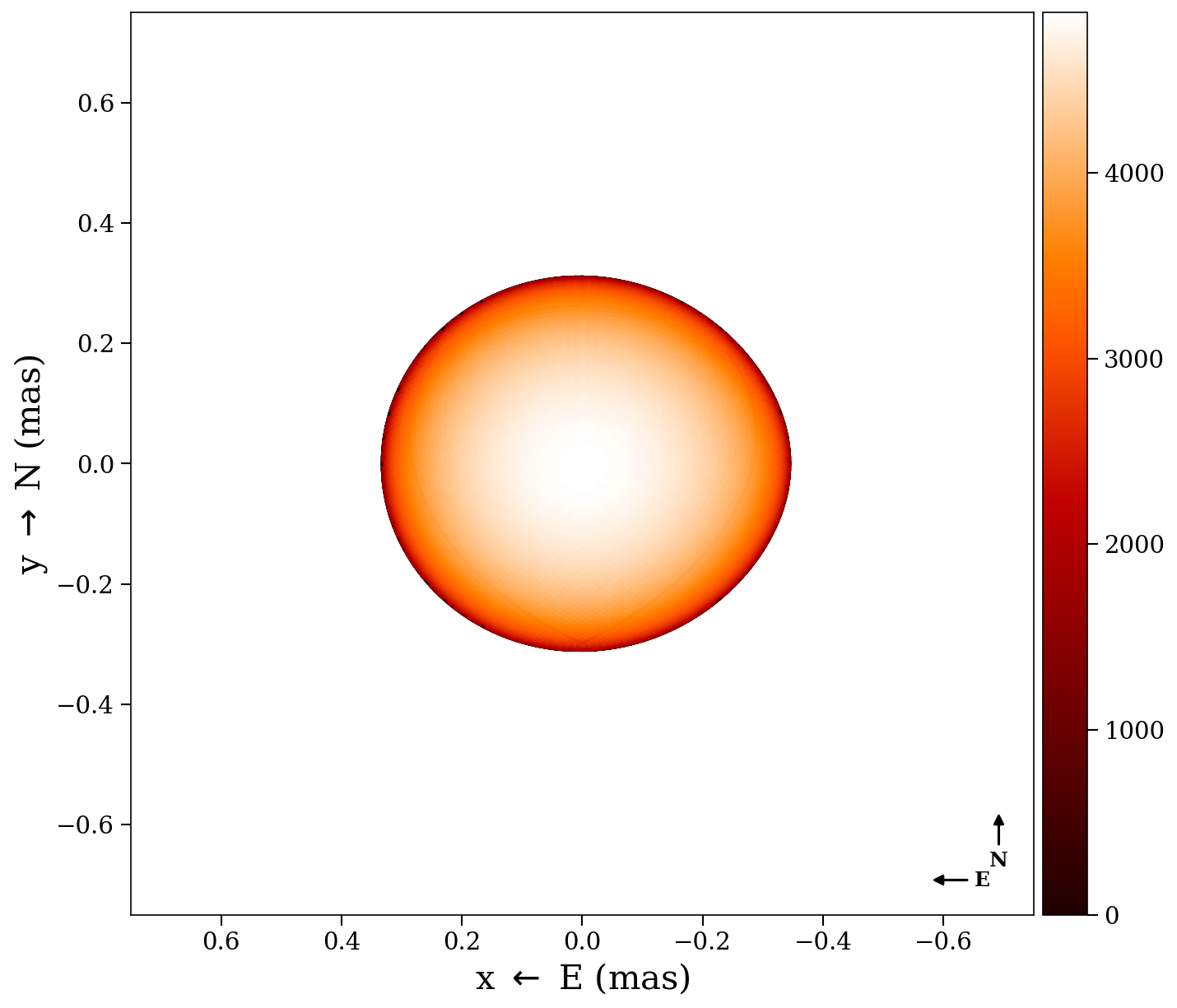
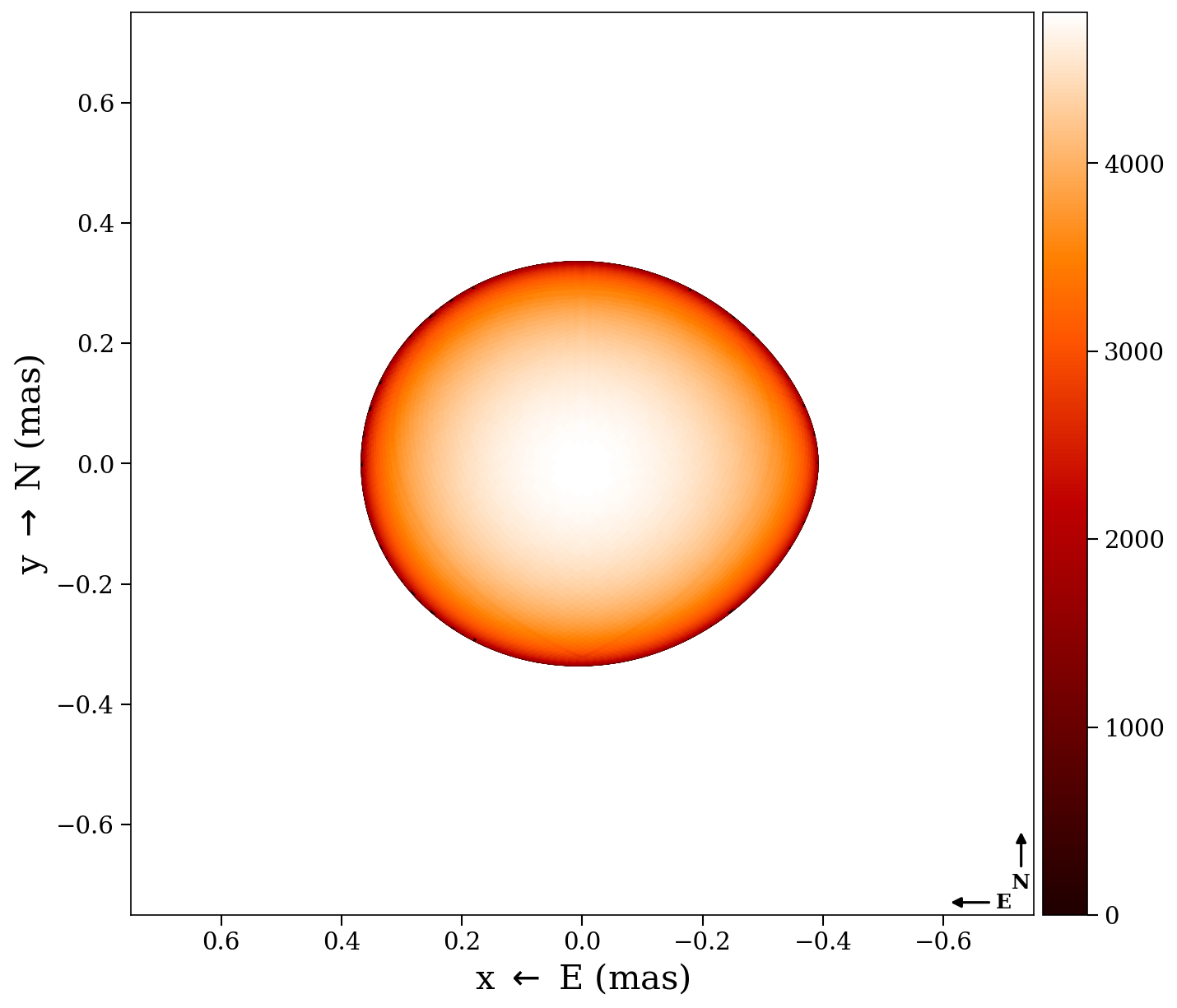
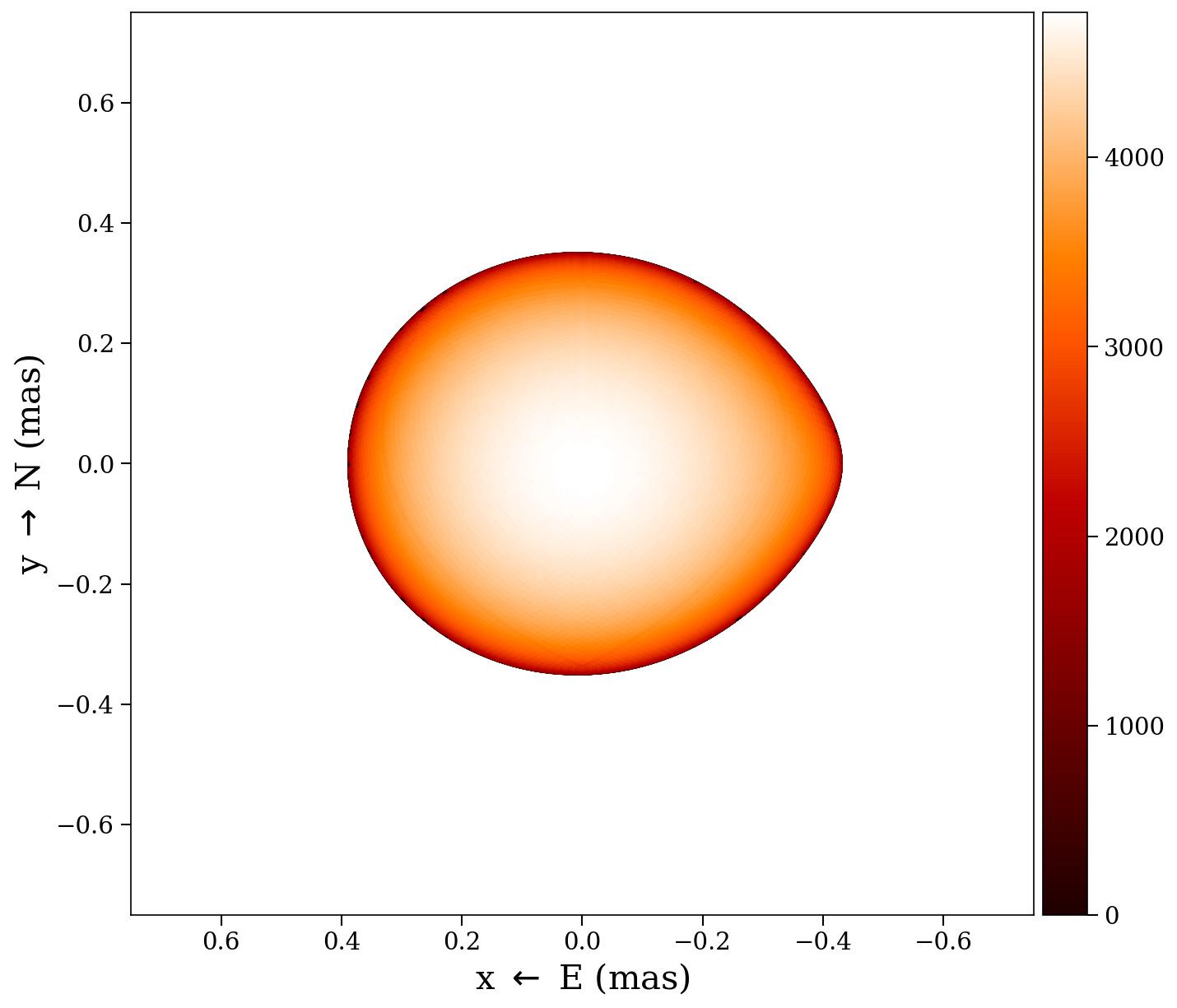
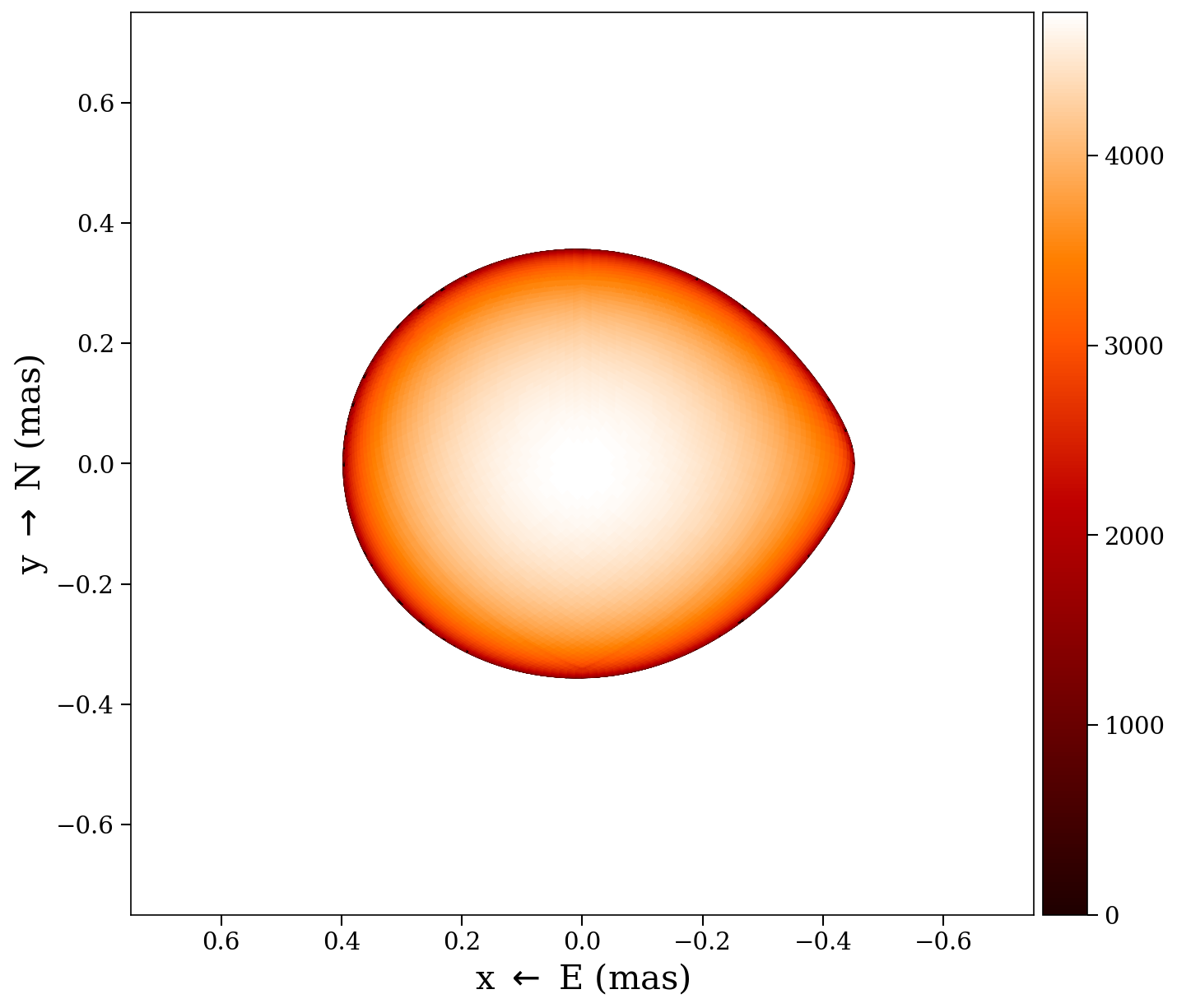
Fillout factor progression
Increasing fillout factor from 90% to 99% of the Roche lobe:
| 90% | 95% | 98% | 99% |
|---|---|---|---|
 |  |  |  |
Roche lobe radius estimates
radius_equivalent_eggleton(q)– Eggleton (1983) approximationradius_leahy(q)– Leahy & Leahy (2015) formula
Temperature maps
For all surface types, a parametric temperature map (von Zeipel gravity darkening) can be generated:
stars = create_star_multiepochs(tessels, star_params, tepochs)
tmap = parametric_temperature_map(star_params, stars[1])
This dispatches to the appropriate function based on surface_type:
- Type 0/1:
temperature_map_vonZeipel_ellipsoid - Type 2:
temperature_map_vonZeipel_rapid_rotator - Type 3:
temperature_map_vonZeipel_roche_single
Limb darkening
Three limb-darkening laws are available, selected by ldtype:
ldtype | Law | Formula |
|---|---|---|
| 1 | Linear | I/I_0 = 1 - ld1*(1 - mu) |
| 2 | Quadratic | I/I_0 = 1 - ld1*(1 - mu) - ld2*(1 - mu^2) |
| 3 | Hestroffer (power) | I/I_0 = mu^ld1 |
where mu = cos(theta) is the cosine of the angle between the surface normal and the line of sight.